

The Myth of Arriving Alone
Why I Finally Chose to Acknowledge the Teachers Who Shaped My Path

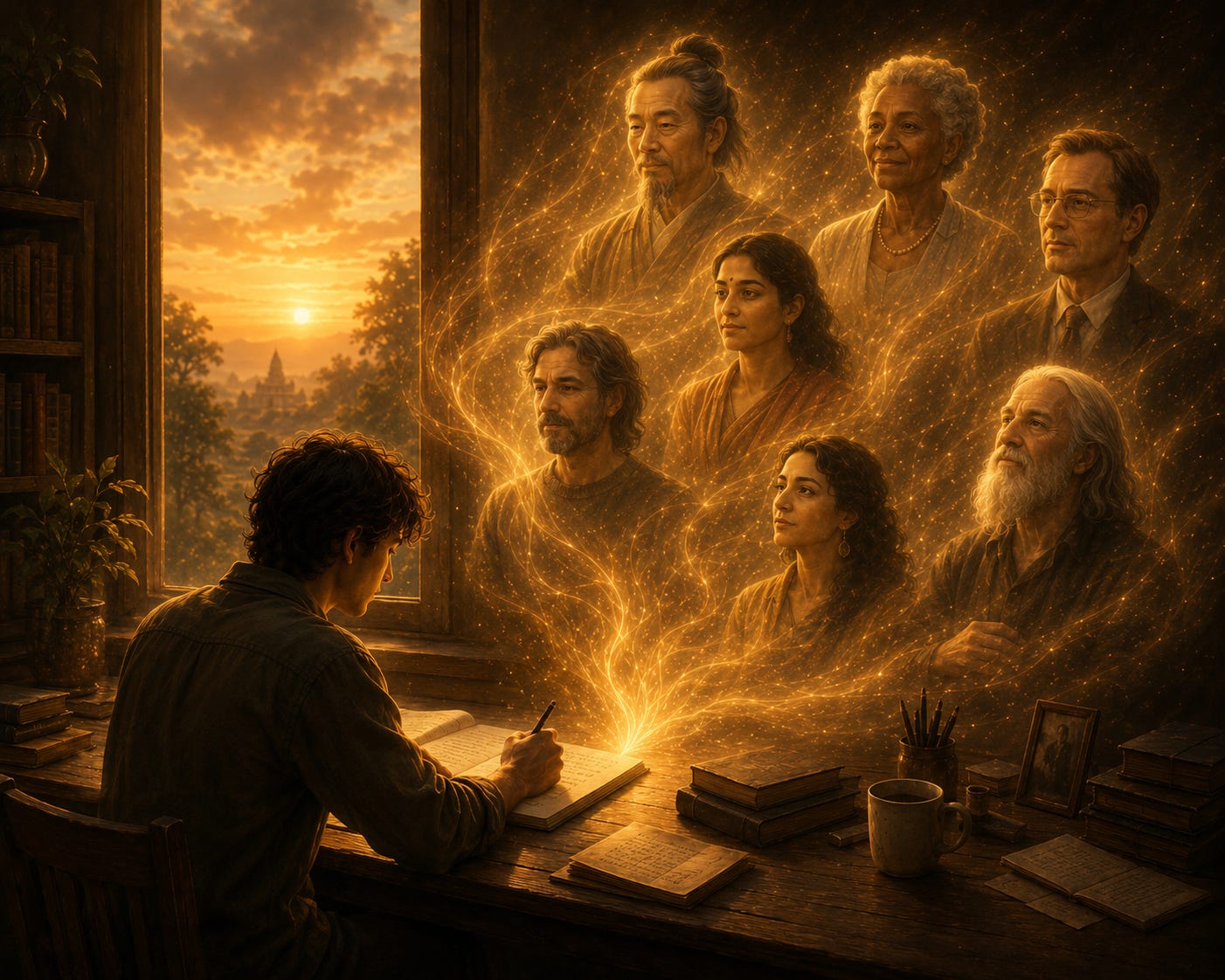
I had a somewhat uncomfortable realization the other day while reviewing my Substack.
Going through my posts, I saw a pattern. While every word I have written comes from my true lived experience, taken together, my writing could still easily leave the impression that somehow, I have “arrived” in life with some kind of finality… all on my own, unassisted.
The moment I noticed it, something within me felt incomplete.
No meaningful realization comes about in isolation. Of course, I’ve had guidance and help… more of the unseen kind than the seen. We all do! And yet, in writing about my life and lessons, I have said very little about the teachers and great ones who continue to shape the person I am, and the life I live.
That omission feels worth correcting.
As I sit here mentally debating whether this omission was conscious or unconscious, I also find myself energized by the thought of finally introducing you to my key influences, whose work has had the deepest impact on me.
So, here it goes:
Since childhood, I’ve had an innate quest to know the Absolute Truth. Call it God, the Universe, the Highest Power, Supreme Intelligence, or anything else you like.
Growing up in India, where daily life often feels infused with a spiritual undercurrent, while my inner quest itself never felt unnatural, I was rarely expressive about it. People in India are generally quite open about their belief systems (at times, a little too much!). I, on the other hand, carried a certain unease and intensity that I kept largely to myself.
Looking back, my spiritual quest was at its peak during my late teens. I was inwardly convinced then (and still am today) that whatever and whoever this Higher Power is, IT HAS TO BE ALL-INCLUSIVE… that it cannot belong exclusively to one religion, one tradition, one culture, or one path.
I had always known within unquestionably that any path that proudly declares itself as being superior while looking down on another is probably not the right path to the Supreme Power at all. What troubled me deeply was the differences and divisions between religions, belief systems, and anything with a superiority-inferiority play.
In the midst of that inner confusion in the late 90s, I encountered my first breakthrough influence.
While working on a university assignment, a classmate introduced me to the book, “Autobiography of a Yogi” by Paramahansa Yogananda. The book arrived at exactly the right time. It cut through the spiritual turbulence I was experiencing, and showed me a definitive path to the Absolute Truth that I was seeking. The book answered numerous questions that I had been carrying for years, and introduced me to the spiritual side of Yoga (a term that goes far beyond physical postures/asanas, and quite literally means union with Self, the God within). I even discovered the actual meaning of my name, Rishi, in a footnote of the book!
The biggest relief and realization Yogananda led me to was that all sincere paths of inner seeking are interconnected and converge toward the same Source… that all differences of religion, race, caste, class, customs, and traditions are superficial and born of ignorance… And that most importantly, Self-realization is the end of all ignorance.
I don’t claim to be a model student of the path of Self-realization Paramahansa Yogananda teaches. Yet his influence has remained one of the most enduring forces in my life.
To this day, Autobiography of a Yogi remains one of the very few books I have read cover to cover. That says something, considering I have always preferred experience to theory.
My second major influence arrived much later, in 2016.
I was between jobs at the time, and yet in a strangely calm and transformative phase. I wrote about this period of my life in my first Subastack post, “The Quiet Shift that Changed Everything for Me”. In that post, I referred to “a chain of seemingly serendipitous events” that drew me into a dimension of understanding I knew very little about.
That chain began with a friend in Australia who suggested I explore the work of Bob Proctor, a leader in personal development. I watched several of Bob’ videos on YouTube. Intrigued, I enrolled in one of his programs and ended up in a Facebook group for participants.
Here’s where things got interesting: During a discussion about books, someone in the group mentioned “Ask and It Is Given” by Abraham Hicks. Again, intrigued, I bought the book. While I greatly admired Bob’s work, and still do, I found myself resonating much more deeply with the teachings of Abraham Hicks, soaking all the wisdom like a sponge.
The part of Abraham’s teachings that reached me most deeply was the realization that I had spent much of my life trying to make things happen through effort alone. When you leave your Inner Being out of the equation and think that you’re doing everything all by yourself, you leave out everything important.
I also learnt that the law of attraction isn’t about brute-force visualization, affirmations, dream boards, and mental gymnastics. Your Inner Being is your deeply invested partner in the manifestation process, and your emotional state is an indicator of your alignment with your Inner Being.
Through Abraham’s teachings, I finally saw how our emotions are guidance from Source itself, and how by consciously learning to be happy and appreciative, we can be in the receiving mode that lets in what we want to achieve. Seeing from Abraham’s lens, I gained a new understanding of how the concepts of “surrender” and “unconditional happiness” that the ancient Indian scriptures emphasize, are not about painful renunciation, but the giving up of inner resistance. I could see the results of the teachings first-hand, leaving no room for mere intellectual theories.
Yogananda taught me what the path of Self-realization is all about and how to approach it through yoga. Abraham taught me to take complete responsibility for everything I experience in my life and stop blaming anything external, including the Creator.
Now, getting back to addressing whether not mentioning Yogananda or Abraham was a conscious or unconscious thing. I am able to see the following three reasons at play:
Centuries of abuse of religious and spiritual authority has taught us to keep our belief systems either scientific, or strictly private. So, the part of us that seeks external validation shies away from acknowledging “abstract influences” for fear of being socially ostracized.
In striving to carve out a place for ourselves in this world, we tend to project ourselves as experts who’ve discovered answers to difficult problems “on our own”. We quietly fear that the world will think less of us if we attribute our wisdom to a Higher Source, the Universe, or other great ones.
Sometimes, it may be too early to acknowledge those who’ve influenced our journey, as we’re still exploring and testing various teachings and belief systems. Endorse an influence then would be premature.
For me it was a mix of all three reasons. Thankfully, I am at a place in my journey where I feel comfortable sharing the influences that have shaped me. In fact, writing this leaves me with an unexpected sense of relief.
I can’t thank enough all these wonderful teachers and Masters whose paths have intersected with mine.
Perhaps that is how guidance often arrives.
Quietly at first. Then, one day, you look back and realize it changed everything.
If this resonated, don’t leave it here. You’re welcome to share it, reflect on it, or tell me what it stirred in you. I read every reply personally.
Rishi
@thefeelingeye